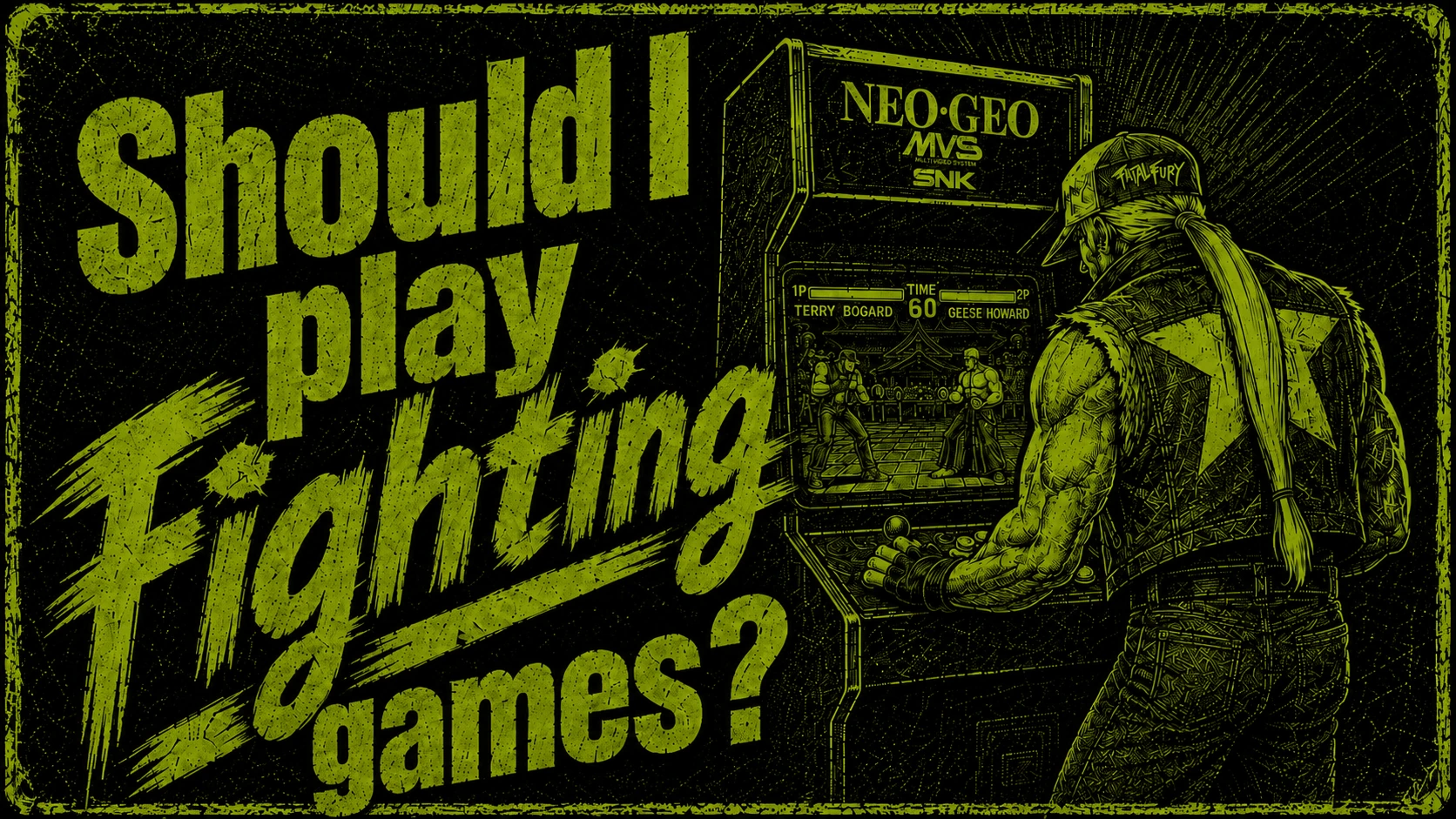
Fighting games are not exactly the most popular genre. If everyone remembers Street Fighter II, it's been a long while since they've been at the forefront of the video game industry. More or less since Street Fighter II was breaking all sales records, actually. That was over thirty years ago. Since then, almost every other genre has passed fighting games in popularity: FPS, TPS, sports, hack and slash, open world RPGs... even match-3 and indie farming games where we grow carrots and pet rabbits sell more than fighting games. So why bother? So before we even ask ourselves whether playing City of the Wolves is worth our time, maybe we should be asking why anyone would want to play fighting games?
Why play Fighting Games?
Fighting games do not offer anything specific to them that cannot be found elsewhere: the reason people can become so passionate about them is because of the cocktail of ingredients they're made of. A good fighting game isn't one that maximises each ingredient independently; it is one in which they reinforce each other.
Challenge
An aspect any player starting out with fighting games realises very quickly is the challenge they pose. This is not about learning how to optimise a skill tree, nor is it about memorising enemies' movements and finding the perfect spots.
Fighting games are much more fast-paced than other genres: they demand instant reactions and are designed around physical human abilities. It takes 200ms for a human to react to a stimulus: fighting games not only have their design bordering on this limit, but they often go beyond what is humanly reactable. This is very central to the genre: if you are being thrown situations you cannot react to, then your only option is to anticipate. This is not just about whether you can better yourself, but whether you can juggle reflexes and careful reading of the situation, all within the same second. Combine this with the complex movements required to execute the moves of a character and you get a perfect contradiction, a context demanding constant risk/reward evaluations at very high speed. The question that is asked every second is: do you trust yourself? Answering this question is the final frontier: the final boss of a fighting game is no one else than you.
Focus
Today's games very often come with huge maps: they offer a near infinite amount of things to do, things to see, places to go, people to see. Yakuza is one such example: you can do so many things that sometimes you even forget what you're supposed to do. The freedom in not just playing the game, but also getting to decide where we want to find our pleasure playing them, is simply fantastic and one of the best things video games have ever offered.
Fighting games have very, very small maps. It doesn't take half an hour to go across them, but three seconds. How is this a good thing, given everything we've said about the joy of freedom? As often, when there is pleasure to be found in the extreme abundance of something, there is an equal amount of pleasure to be found in the privation of that thing. Playing a high-speed game in such a confined space makes everything count: your strategical choices have no room for failure, your execution has no room for error and your attention, literally, has nowhere else to go. Such a confined space creates tension and brings focus. All the time you have spent training, preparing, anticipating, trying, optimising: it all comes to this, right here, right now.
With the tension we're describing above, where rich situations must be analysed and then solved by executing complex series of commands at lightning speed, this means that instead of a total freedom in deciding how you want to play the game, there is extreme focus on improving every day you play.
Hardware
Hardware is quite an interesting aspect here. Most of the time, it doesn't take the latest gaming PC to run a fighting game: just about any PC from ten years ago will do. You're never pressed to upgrade your hardware, and you won't be spending any time trying to optimise your graphics card, gently stroke your memory sticks when no one is looking or keeping an eye on the diet of your CPU. You get to save your money for more pressing needs.
One such need is the controller. There is an incredible variety of controllers available, all dedicated to playing fighting games: evolutions of the regular controller, arcade sticks, leverless arcade sticks, ergosticks... With the advent of 3D printing, many players even take it upon themselves to design their own equipment. If there's a debate whether you actually need something else than a regular controller, the question is rather whether you just want one. A controller you can make your own, customise, change the components, the art to sport your favourite colours, character or even your name...
Depth
What fighting games lack in breadth, they certainly compensate in depth. Two games come to mind that share a lot of similarities with fighting games, perhaps surprisingly: Shadow of the Colossus and Dark Souls. In these games, the player is tasked with understanding the patterns exhibited by a series of unique opponents: how they move, how they strike, how they defend, what makes them vulnerable. Analysing their responses, working on your skills where they're lacking, practising relentlessly, again and again, until what used to be hard becomes routine, very hard melts down to achievable and impossible turns into the long-term goal. The whole gameplay revolves around the exhortation: rise to the challenge. Fighting games are exactly this kind of boss rush games: you face a series of opponents and need to learn how to beat them. The pleasure is in learning, and this is where a deep game system can bring the experience to new levels. Every detail in the system is a little weapon at your disposal, an element of response you can use to beat your opponent. Learning how every aspect of the system favours your character or your opponent, developing tactics and strategies to ride the mechanics and bend the odds: your resourcefulness directly depends on your understanding of the game.
But fighting games add another element missing from the two games mentioned earlier: if you can play against the CPU in a variety of modes, the game is typically played against other human beings. Every player is on the same journey to understanding and mastery, just like students in a dojo. The differences in character, approach, style, taste, ego: this is what makes fighting games not just a deep experience, but a bottomless pit of joys and tears. The journey literally never ends, and this explains why games that came out 10, 20, 30 years ago still have an active scene of players and even circuits.
Psychology
As mentioned above, a distinguishing trait of fighting games is their versus aspect. Mastering the moves of your character is your vocabulary, mastering the mechanics is how you express yourself, and facing another player in the game is where the discussion takes place. There is indeed a language to fighting games, where statements are made and rebuttals are thrown; carefully crafted strategies get melted down by simple answers the player failed to anticipate, comfort zones are burnt down, players are dragged in situations they fear. If on the screen, the damage is dealt on the life bar, the target really is the player's mental resources. Deny the strengths, find the weakness, exploit it until confidence runs out, until the nerves let go, until the hands are divorced from the reason. It's possible RTS offer this kind of psychological warfare, but fighting games make it unfold at lightning speed.
Characters with character
One prominent aspect of fighting games is the roster of combatants they offer, and the amount of care they put into them. The reason is simple: as we've seen, players are going to spend their time perfecting moves, chaining combos, understanding strengths and weaknesses of the fighter they pick, as well as all the situations they will face. Fighting games have a particularly strong incentive to make characters relatable: through hundreds of hours of hard effort, players tend to get emotionally invested. They need to become intimate, one projecting themselves into the other; truly like hand in (boxing) glove. So characters in fighting games have a backstory, tastes in food and hobbies, develop rivalries and friendships with other characters... Their personalities, styles and motivations, the players need to be able to make them theirs, just like book readers can identify themselves with the protagonist in a novel. In fighting games, the character is the avatar, the player is the protagonist.
Stylish visual effects
Even if fighting games can't usually offer graphics at the level of large-budget, AAA games, they do offer their share of spectacular sequences: these past few years, game studios have rivalled in terms of creativity to offer us long, rewarding animations for supers. Not only is this enjoyable, it also anchors what makes the characters who they are: cunning, powerful, agile, acrobatic, crazy, messy, cocky, neat and professional... This is one satisfying way for all our investment to pay off in one rewarding cinematic performance!
A unique community
The last very important aspect to fighting games that is characteristic to them is their community. The Fighting Games Community, or FGC, is a direct descendant of the arcade community, and as such, is one of the oldest self-aware communities in video games. It largely predates the emergence of esports, and this is very evident in FGC events. These events tend to be run by the community itself rather than being professionally organised in a top-down manner. In this culture, the bracket is open to anyone, and anyone can challenge the world's best player. And because their subject is so intense, they always offer an electrifying experience.
What makes the community so important is also the contrast: during a round, the player is very much alone but when the time comes to grow the mastery, this happens within the community. Every individual learns via the community, and the community grows and becomes better, as a whole, with every player that joins it. Precisely like a dojo. The path to becoming strong is best not walked alone, but in the company of the community. Secret techniques do not survive the community trial. We've also talked about the psychological aspects, and how fighting games can be demanding in this domain: the community is literally made of people going through the same journey. The happy moments, the disappointments, the self-doubt, the epiphanies: every player goes through cycles of these, and the understanding is immediate.
As with any good hobby, you come for the hobby, you stay for the people.